Why Nokia’s 5G Business Just Became an AI Story (and Who Wins)
Investors old enough to remember the advent of mobile phones in the 1990s probably still think of Nokia (NOK -0.78%) as a phone manufacturer. It’s not actually in the business anymore, however.
Some mobile phones still bear the Nokia name, but it’s only licensed by mobile phone maker HMD; Nokia only makes some of the technological components found within modern-day mobile devices. Its big business these days is the networking and connectivity hardware required by cloud computing, mobile carriers like AT&T and Verizon Communications, and institutions.
This business is about to get a whole lot bigger, too. Credit the growth of artificial intelligence (AI), mostly. Here’s why and who wins.
Nokia is leading the charge of much-needed change
If you weren’t aware, the 5G connection your smartphone most likely utilizes is short for fifth-generation mobile broadband connectivity — an upgrade from measurably slower previous-generation 4G technology. And it arrived just in time. Thanks to the explosion in artificial intelligence, end users are wirelessly sending and receiving more digital information than ever before. Industry expert Aetha Consulting reports that generative AI traffic alone is driving more than twice as much uplink (from user devices to the network) data traffic as ordinary mobile traffic does.
This traffic is only going to continue growing, potentially by as much as 10 times the load mobile networks are currently experiencing. They’re not ready for that. Neither are the nonpublic wireless networks used by factories, campuses, and the like.
Finland-based Nokia is getting them ready, though. Last October, Nokia announced it would begin developing sixth-generation, or 6G, radio access network (RAN) technology capable of handling the data load AI is creating.
This equipment looks and functions much like 5G and earlier tech, with one key exception: It will be powered by artificial intelligence itself. It has to be. There’s no other option capable of optimizing the swell of digital traffic that awaits.

Today’s Change
(-0.78%) $-0.08
Current Price
$9.51
Key Data Points
Market Cap
Day’s Range
$9.30 – $9.62
52wk Range
$4.08 – $17.45
Volume
17.3M
Avg Vol
108.5M
Gross Margin
44.14%
Dividend Yield
1.70%
The company has recently made a major developmental leap, too. Just last month, Nokia announced the official launch of its — and the industry’s — first commercial AI-RAN platform, which offers 20% higher spectral efficiency (spectrum refers to the range of radio frequencies permitted for this purpose) than current systems. The company expects to realize 50% gains next year, en route to a 100% improvement in spectral efficiency by 2028.
This will, of course, better equip the telecom industry to handle growing, AI-driven mobile data loads. These flexible, upgradeable, software-centered hardware will also set the stage for what will eventually officially become 6G connectivity, likely sometime around 2030.
Up for grabs is a piece of the 6G networking equipment market that should be worth more than $50 billion by the first half of the 2030s, growing more than 20% per year in the meantime. For perspective on that figure, Nokia did about $23 billion worth of business last year.
The opportunity, however, isn’t just Nokia’s, because it’s not building these AI-powered next-generation solutions alone. It’s got a partner that will participate in this growth. Two of them, actually.
Yes, Nvidia
It will come as no surprise that AI hardware powerhouse Nvidia (NVDA +0.08%) is involved. It was named as a codeveloper all the way back in October, in fact.
Specifically, Nokia’s new AI-RAN platform utilizes Nvidia’s also-new Aerial RAN Computer Pro (ARC-Pro), a purpose-built accelerator that combines connectivity, computing, and telecom-related sensors. Although built to work with existing 5G connectivity technology, this equipment can be easily upgraded to serve as the backbone of 6G networks when the time comes.
Nokia doesn’t have to be Nvidia’s only AI-powered RAN customer, though. Indeed, perhaps the most fruitful outcome of this and similar development partnerships will be the discovery of additional ways Nvidia can leverage the new know-how from telco-focused AI accelerators. Small-scale settings, such as the aforementioned campuses or factories, come to mind.
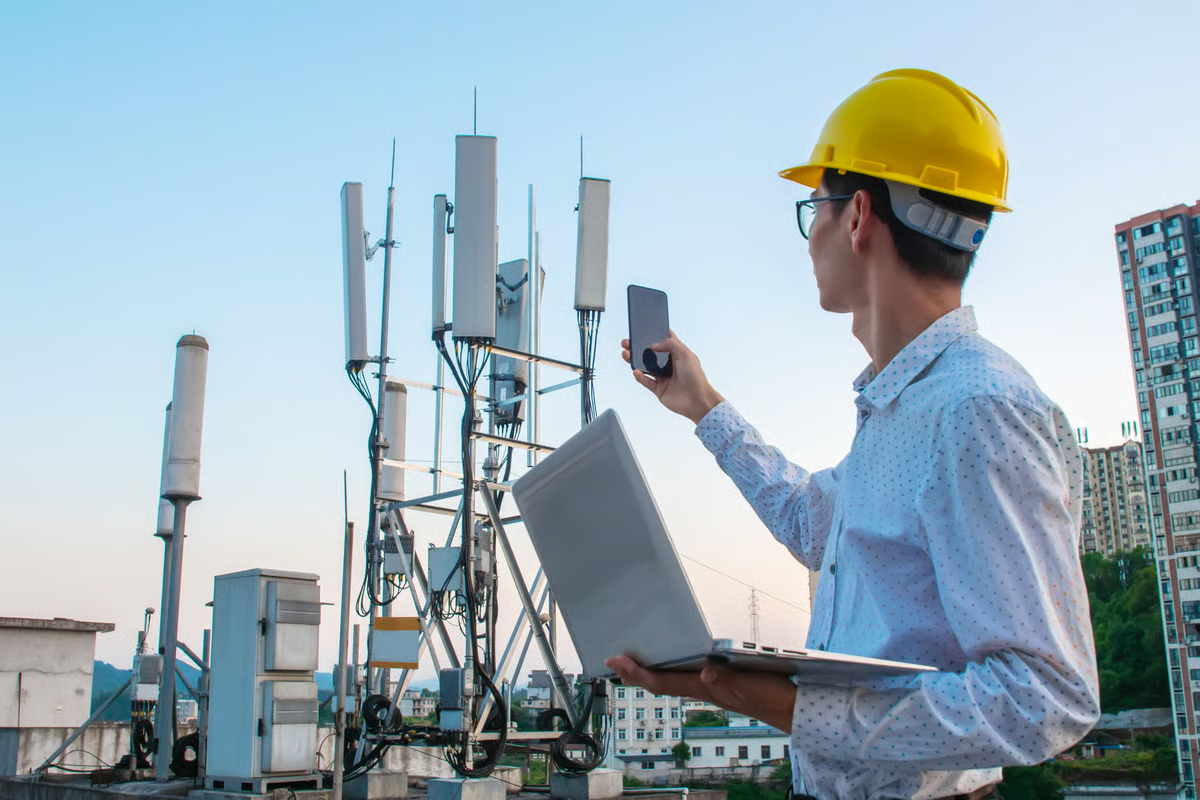
Image source: Getty Images.
Computer company Dell (DELL -3.40%) is the other related winner. It’s arguably one of the market’s most unexpected AI entrants. Although servers, desktops, and laptops were and still are at the core of its business, after a somewhat slow start, the so-called AI Factory that Dell introduced in 2024 is finally gaining serious traction.
Last quarter’s revenue of $43.8 billion was an eye-popping 88% year-over-year improvement, led by 757% growth in its AI-optimized server business. More relevant here and now, whereas Nvidia’s ARC-Pro is the backbone of the artificial intelligence piece of Nokia’s new AI-RAN technology, Dell’s PowerEdge servers provide the rest of the necessary technological/computer framework.
You’ve got time to make smart moves
This is obviously bullish for all three stocks… perhaps even more so than most investors realize. Just bear in mind that, at least for Dell and Nvidia, both outfits have far more AI-related opportunities ahead of them than higher-performance wireless networks. This brewing revolution that will eventually become 6G connectivity is still only part of their respective futures, and a slower-moving part at that.
That’s not the case for Nokia, of course — the accelerating growth of AI-related mobile traffic moves the revenue needle in a much bigger way for the Finnish outfit.
Moreover, thanks to the stock’s 40% pullback from its early June peak, NOK shares are now down nearly 30% from the analysts’ consensus target of $12.81 that arguably indicates this new networking tech will begin bearing fruit sooner than the market realizes. Ditto for the fact that the majority of these analysts currently rate Nokia stock as a strong buy.
Whatever the case, the slow-moving but inevitable march toward 6G mobile connectivity is one well worth putting on your radar, as you look for the expected — as well as unexpected — results of this transition.