When Clients Won’t Sell: What Actually Helps Clients Let Go (Of The Endowment Effect)
As human beings, most of us have a hard time letting go, especially in cases where we have held something for a long time and formed a personal attachment to it. From the treasured (blue) coffee mug, to the t-shirt we got at that concert, to the higher-stakes situations like the family home we’ve lived in for years, or the company stock we’ve built up over decades that made it possible to retire. The good news is that our human tendency to create attachment enables us to invest into ourselves and our community. The bad news is that it can create a resistance to change. Such an unwillingness to sell is especially problematic in situations like real estate or concentrated stock positions, which create real financial planning hazards that advisors must help their clients navigate.
In this guest post, Dr. Meghaan Lurtz, a leading expert on the psychology of financial planning and Professor of Practice at Kansas State University, explores the research behind this phenomenon (known formally as the “endowment effect”), how it typically manifests in financial planning situations with clients, and more importantly what financial advisors can actually do to help their clients get more comfortable with selling an asset that needs to be sold.
The endowment effect is complicated, though, because it’s actually driven by three different mechanisms, any one of which (or sometimes a combination thereof) may be at play in any particular situation. In some cases, it’s driven by loss aversion – the recognition that the pain of loss is twice as impactful as the joy of a comparable gain, which causes us to ask a lot more when selling something than we would ever pay to buy it. In other cases, our own identity gets tangled up into the situation… such as the concentrated stock position that was accumulated through years of employment, making it more difficult to sell since we feel that we earned it through the fruits of our labor and our success as a career professional. And sometimes, it’s simply a result of different anchor points between buyers and sellers: when we’re asked to let go we often think of the highest price it could be worth (e.g., what the most expensive property on the street ever sold for), while the buyer looks at how inexpensively it might be obtained (e.g., what the least expensive property in the area went for).
Being aware of when these dynamics are at play is important, because the emotionally driven phenomenon is not responsive to logic as a cure. Which means it’s not enough to simply know that the endowment effect is at play, and it’s especially unhelpful to communicate it that way to clients, as suggesting that their unwillingness to sell is ‘a result of their biases’ is more likely to elicit defensiveness than a concession that they need to take action.
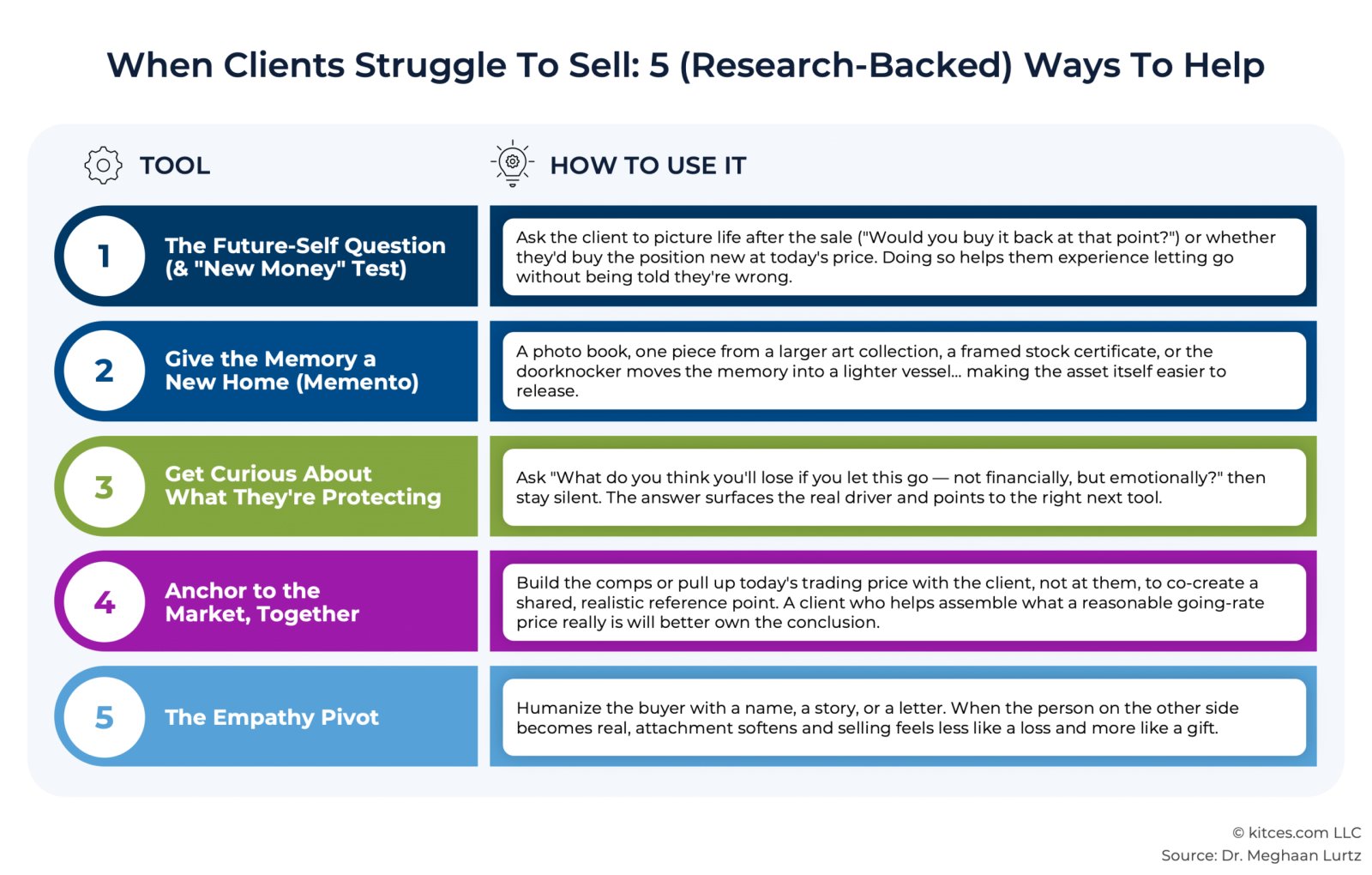
So what does work? Psychology research on the endowment effect suggests several paths. One approach is to have clients envision what their future life might look like, after a sale has already occurred, to help them get comfortable with being on the other side of the sale. Another option is to encourage them to capture a memento – from the doorknocker or a key piece of art from the family home they’re selling, to perhaps a framed stock certificate of that company stock they held so long (and are now getting ready to liquidate) – to diminish the pain of the loss by having something to keep. Other tactics include working alongside with the client to re-anchor to a realistic price in the current environment (e.g., “Let’s look together… at what comps are selling for” or “…at what price it’s trading today”), trying to help the client get familiar with who will be on the receiving end of the sale (e.g., get to know the family that’s looking to buy and move into your family home), or simply asking, “What do you think you’ll lose if you let this go – not financially, but emotionally?” so the client can surface and start thinking through their own worries.
Ultimately, the key point is to recognize that an unwillingness to sell something we’ve had a long time and/or formed an attachment to is normal, is human, and is not simply a matter of showing enough logic to ‘prove the point’ that it’s a good financial planning decision to sell (even if that really is the case). Instead, because the reality is that the endowment effect is first and foremost an emotionally driven phenomenon, helping clients unearth that emotion, name it, and do their own work to begin working through it is the better way to help them begin to let go and engage in the sale of the asset.
 |
And if you want to go deeper on this topic, hear directly from the author on the Financial Advisor Technician podcast . |