How Lettuce Linked to Cyclosporiasis Outbreak Can Get to Your Table
Don’t blame your salad if you’ve gotten sick in the outbreak of cyclosporiasis, an intestinal illness linked to contaminated iceberg lettuce. Instead, blame what’s on it.
Cyclospora cayetanensis is a tough microscopic parasite that can give you watery diarrhea and frequent bowel movements. It can be found on produce in the field and isn’t easily removed by washing or common sanitizers.
At least 6,707 cyclosporiasis cases have been confirmed and another 11,500 reported to the CDC as of July 28.
An investigation by the Food and Drug Administration linked the outbreak to iceberg lettuce served at Taco Bell restaurants sourced from privately held Taylor Farms operations in central Mexico. Walmart and Sysco have joined Taco Bell in removing potentially affected lettuce. Health officials are searching for other potential sources.
The connection to lettuce has raised questions about how and where food is grown, processed and imported into the United States. Here’s a closer look.
The 9-Step Journey From Farm to Table
- The recalled lettuce was grown in central Mexico at a specific independent farm and was voluntarily recalled in the United States by Taylor Farms de Mexico in Guanajuato, the FDA said. Taylor made the announcement July 17. The farm itself has not been identified.
- The lettuce was processed, including being chopped or shredded, in central Mexico, Taylor Farms said. It was packaged in 5-pound bags, with cases containing four bags each used for shipping.
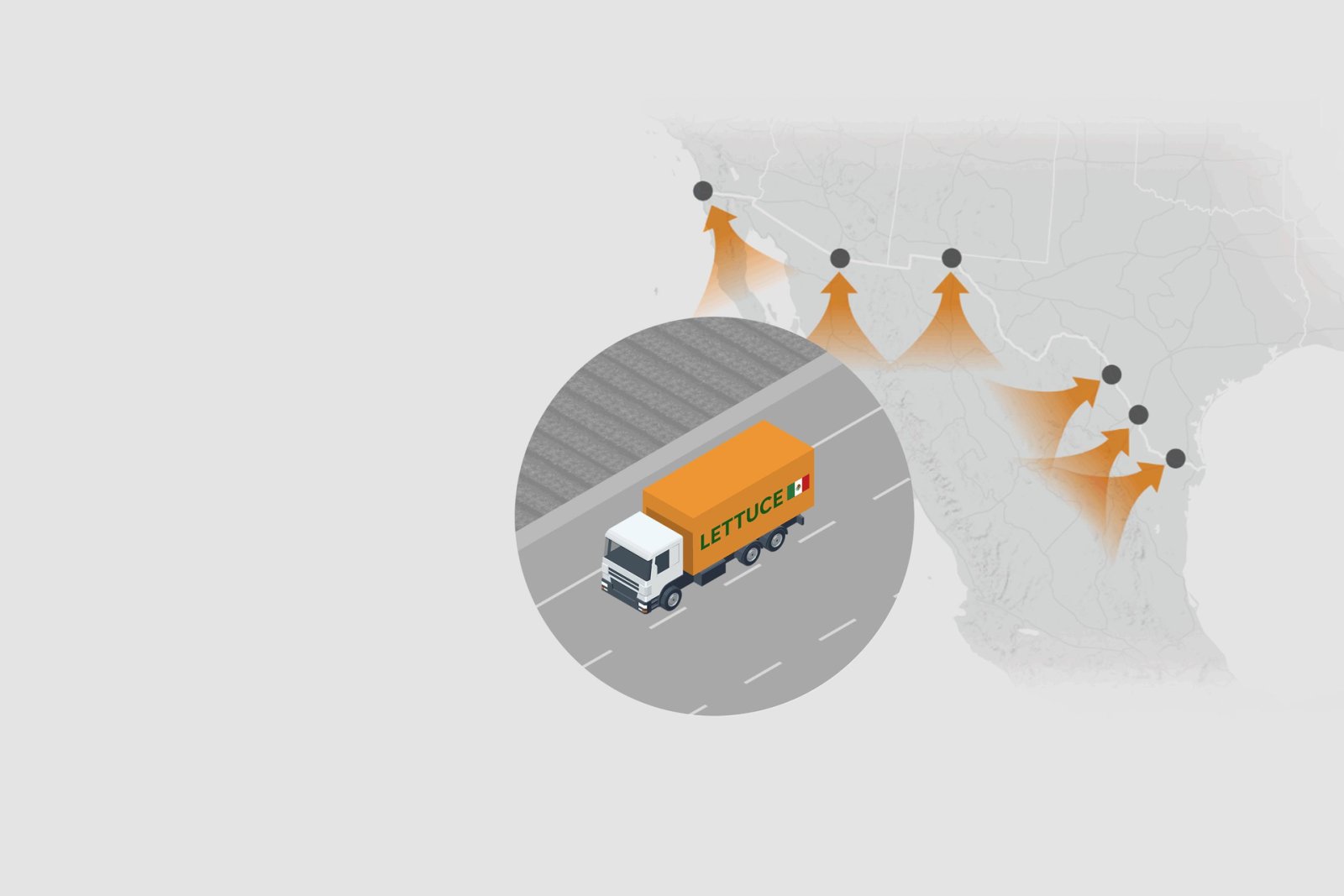
- The processed lettuce was shipped, probably aboard refrigerated trucks. Though the recalled lettuce was sourced from central Mexico, where the trucks were loaded has not been identified.
- Fresh lettuce from Mexico typically arrives at a warehouse via a refrigerated truck “cold chain” — a system of refrigerated trucks, warehouses and transfer points used to keep the lettuce cold at every step along the way.
- Trucks enter the United States via one of six points of entry. For lettuce coming from central Mexico’s Bajío/Guanajuato region, the likely U.S. border gateways are in south Texas, which is much closer logistically than other crossings.
- Specialized short-distance trucks cross the border into the United States. On arrival, the produce passes through customs and border drayage — specialized short-distance trucking that bridges the gap between national borders.
- The lettuce is transferred to U.S. distribution trucks. After clearing customs, it’s taken to a cold-storage or cross-dock facility, where it’s transferred from one refrigerated truck to another.
- A U.S.-licensed carrier usually completes delivery, taking the lettuce to distribution warehouses, restaurants, grocery stores and other purchasers. Once cleared by federal agencies, imported food can move through normal supply chains to retailers, warehouse clubs, convenience stores or food-service distributors like Sysco or US Foods, which supply restaurants, hotels, schools and hospitals.
- The lettuce ends up on tables across the country.
Where Cyclospora Comes From
The parasite comes mainly from people — “humans appear to be the only major host,” according to the Centers for Disease Control and Prevention. Field produce can be contaminated by people who carry cyclospora and who may not be able to practice good hygiene. The parasite can be shed in human feces, mature in the environment, and spread to fresh produce and irrigation water. Contamination can happen almost anywhere along the supply chain: in the fields, at harvest, and during cutting, processing, packaging, transport and delivery to a supermarket or restaurant.
“And so there is really a wide potential for areas for contamination, which is why training, good hygiene practices, cleaning and sanitizing are so critical throughout that entire process,” Kalmia Kniel, a professor of animal and food sciences at the University of Delaware, said in a briefing July 28.
How Much Lettuce Does the U.S. Import From Mexico?
Though much of the produce consumed in the United States is produced domestically, the amounts vary depending on the vegetable. About 8% of the lettuce sold in the United States each year is imported, according to the FDA.
Mexico accounted for about 88% of the lettuce imported in 2024, and Canadian imports accounted for about 11%, Forbes reported.
Lettuce production is seasonal: California grows about two-thirds of the domestic lettuce supply, with peak season from April to October, while Arizona has peak harvesting seasons between November and March. Experts say the fraction of imported lettuce from Mexico helps fill some of the supply gap left by California’s off-season.
“It’s not because we want to import it. It’s because we want to consume it, and the domestic production doesn’t satisfy it,” said Luis Ribera, an agricultural economics professor at Texas A&M University.
U.S. lettuce production overall has stayed relatively flat, said James Sayre, agricultural trade economist at UC Davis, largely because domestic locations with ideal growing conditions for lettuce are maxed out.
In May, the U.S. imported nearly 28,000 metric tons of lettuce from Mexico, based on data from the U.S. Department of Agriculture — an increase of nearly 50% compared to the same month last year, and a record import value worth over $50 million.
“We had pretty hot weather in Yuma, AZ and Salinas, CA this spring, which hit yields on lettuce right around May,” Sayre said, explaining the May trend. That means less domestic supply on the market, rising prices, and produce companies turning to Mexican imports to fill the gap.
How Cyclosporiasis Cases Have Grown
At least 6,707 cyclosporiasis cases have been confirmed since May 1, the CDC said in its weekly update July 28. Cases have now been recorded in 45 states. More than 11,500 additional cases, primarily in Michigan and Ohio, have not yet been confirmed by laboratories. There have been 423 hospitalizations and no deaths.
It’s more difficult to track the source of a cyclosporiasis outbreak than outbreaks of other foodborne illnesses. Cyclosporiasis has a long incubation period, and it’s tough to obtain samples. Genetic tracking tools used for pathogens like E. coli and listeria can’t be used for cyclosporiasis.
Contributing: Sara Moniuszko, Mike Snider, Mary Walrath-Holdridge, Janet Loehrke, Carlie Procell and Shawn J. Sullivan. Source: USA TODAY Network reporting and research; Reuters; Centers for Disease Control and Prevention; Food and Drug Administration.