A $506 million bet on thousands of New York rent-stabilized apartments has already soured for bond investors. Mayor Zohran Mamdani’s rent freeze threatens to make it worse.
The commercial-property bond, backed by the mortgage on 53 buildings across Queens, Brooklyn, Manhattan and the Bronx, has piled up more than $5.5 million in past-due interest after payments to its riskiest tranches fell short. Analysts at KBRA Credit Profile value the properties at about $460 million, compared with an appraisal of about $717 million when the bonds were sold five years ago, implying losses of more than $80 million for bondholders.
Last month bondholders escalated efforts to foreclose on the portfolio in a bid to salvage their investment, according to deal documents.
The transaction’s unraveling highlights the pressure on New York apartment owners confronting higher borrowing costs and rapidly rising insurance, maintenance and utility bills. A&E Real Estate defaulted when the mortgage matured in 2024 after failing to refinance as interest rates surged. By late last year the units, roughly 86% of which are rent stabilized, were generating just 58 cents for every dollar of debt payments.
The deal has become a closely watched barometer of the investability of rent-stabilized housing sectors in New York and, increasingly, nationwide as more cities tighten or consider rent controls. Market watchers say the looming freeze — a central promise of Mamdani’s campaign that launched him into City Hall — will further erode recoveries and discourage capital from flowing into the sector. The freeze will apply to about 1 million apartments starting in October, representing about 40% of the city’s rental units.
“A key question is, who will buy this distressed loan to lower losses in this deal if no rent increases are allowed?” said Phillip Millman, a former official at the Federal Housing Finance Agency who now runs his own consulting firm. “If the freeze goes into effect, it increases the losses significantly, which means even more bondholders are likely to be impacted.”
Representatives from Mamdani’s administration declined to comment on the transaction. But the administration has disputed assertions that hiking rents will solve landlords’ problems with inflation. It has announced policies to help landlords defray operating expenses.
Bud Perrone, a spokesperson for A&E, said “We remain in constant communication with both the senior and mezzanine debt holders as we seek a resolution that serves the best interests of everyone involved, most especially the hard-working New York City residents who call these buildings home.”
The bond’s collateral includes Riverton Square, a 12-building, 1,229-unit complex in East Harlem; La Mesa Verde, a six-building, 324-unit property in central Queens; and Queens Boulevard Apartments, three six-story buildings containing around 200 units, five professional spaces and a below-ground garage.
The deal, known on Wall Street as JPMCC 2021-NYAH, was a part of a 2021 refinancing wave when ultra-low rates encouraged property owners to replace older debt. The floating-rate, interest-only mortgage was initially paired with a rate cap that held A&E’s effective borrowing cost near 3.66%, roughly half the rate it would later face without the hedge.
By the time the mortgage matured in 2024, operating expenses were running 13% above expectations as insurance premiums and other costs surged, according to an analysis by broker-dealer Academy Securities. Meanwhile, tenants at properties including La Mesa Verde would file multiple lawsuits alleging poor building conditions and seeking court-ordered repairs, claims A&E has disputed.
A&E was ultimately unable to repay or refinance the balance, leading to the default. The deal has continued paying interest on most of its bonds, but only because the servicer has advanced about $29 million since A&E stopped making some of its debt payments. Financials from last year show annualized expenses were approximately 22% above initial levels, compared with a roughly 6% increase in revenue.
It’s unclear how badly landlords will generally get hurt by the freeze. Fitch Ratings says the rent freeze will further strain building finances across New York and erode cash flows as operating costs continue to increase, pressuring valuations and refinancing prospects. Moody’s Ratings, in turn, warned that a prolonged freeze for regulated units would push 6% of the city’s CMBS multifamily loans toward potential defaults — though it also concluded overall credit risks are limited, in part because CMBS deals often feature some market-rate units as well.
“To be able to attract the levels of capital needed to properly maintain and grow NYC’s housing stock, the Mamdani administration needs to find a way to assure lenders and investors of the potential to recover their principal along with a reasonable, risk-adjusted return on their money,” said Mark Willis, a senior policy fellow at New York University’s Furman Center.
Greg Corbin, founder of Northgate Real Estate Group, a brokerage that focuses on distressed properties, points to a section of the mayor’s “Block by Block” housing plan that says distressed housing portfolios will be stewarded to “vetted, responsible landlords,” including community land trusts and tenant cooperatives, who could stabilize them.
“Institutional and private capital is exiting, lenders have pulled back, and the city has made clear it wants nonprofits and land trusts positioned to catch what falls,” Corbin said.
When asked whether city policies were pushing out private landlords, a spokesperson pointed to the mayor’s plan to develop a program to help cut insurance costs for owners of affordable housing. In April, Leila Bozorg, the deputy mayor for housing and planning, said in an interview with City Limits that the administration is “ready and willing to work with any and all stakeholders who want to help address the broader housing affordability crisis,” adding that the city wants to support responsible property owners.
‘Major Headwinds’
The $506 million deal is hardly the only one tied to New York rent-regulated units coming under mounting pressure.
Buyers of a $225 million CMBS backed by a pair of apartment towers in Jamaica, Queens, are facing more than $100 million in losses, according to KBRA Credit Profile. Then there’s a group of six separate CMBS securitizations exposed to two large apartment complexes in Manhattan’s Upper East Side, which could also deliver losses to junior bondholders, KCP projects.
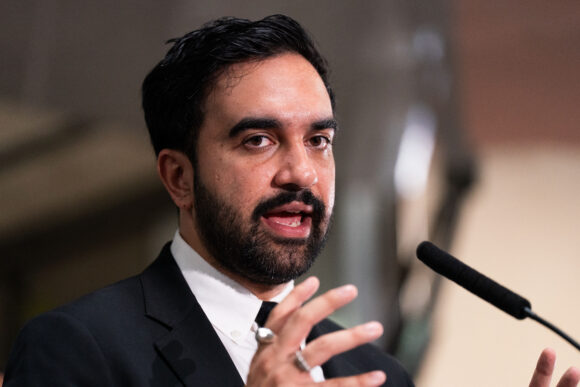
Landlords, for their part, have gone to court to try to derail the rent freeze, arguing that Mamdani improperly influenced the Rent Guidelines Board’s vote and ignored evidence of the rising costs building owners face.
It may be too late for holders of the lower-ranking slices of JPMCC 2021-NYAH. A $31 million tranche near the bottom of the capital stack is quoted at about 49 cents on the dollar, while the $47 million slice one rung above trades at roughly 64 cents, according to data compiled by Bloomberg.
“The performance and financing of rent stabilized properties did not pan out as expected not just because of rent regulations,” said Stav Gaon, head of securitized products research at Academy Securities. “Landlord cost increases and rising interest rates also have been major headwinds.”
Top Photo: The Riverton Square apartment complex in Harlem, New York, part of the collateral on the bond.
Copyright 2026 Bloomberg.