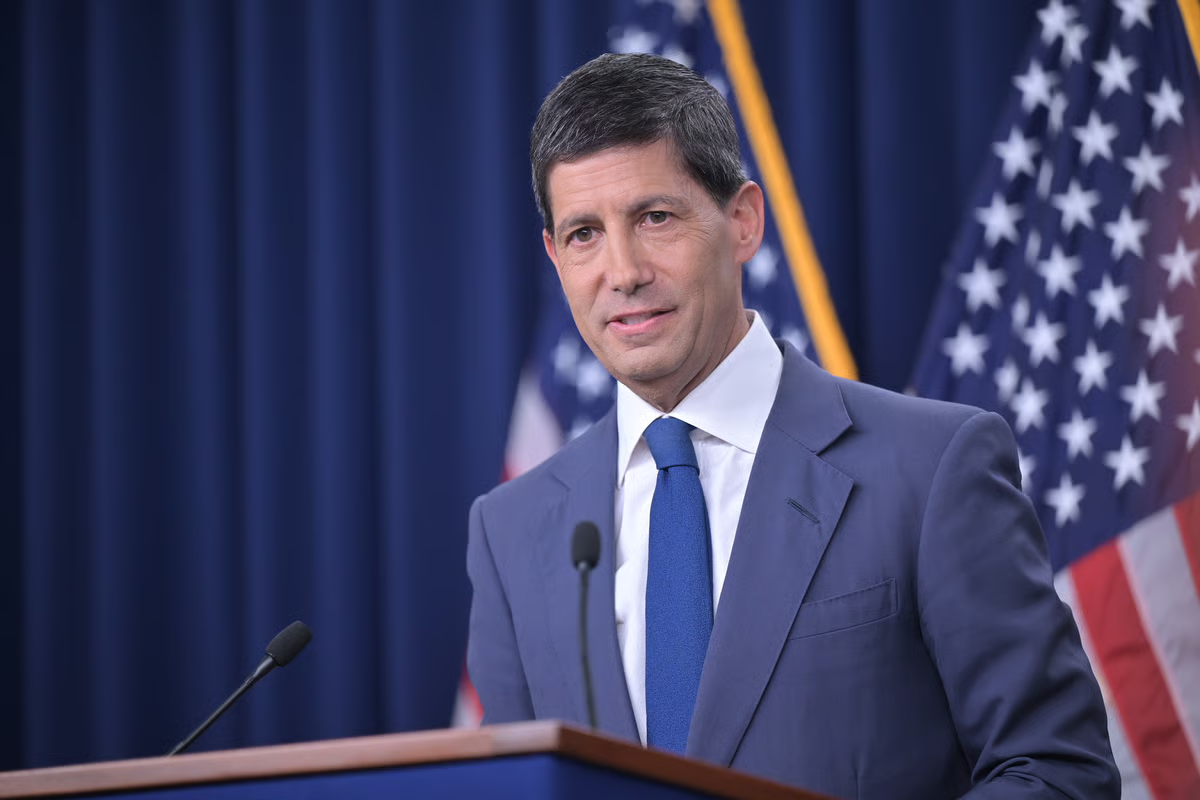
The Bond Market Just Called Fed Chair Kevin Warsh’s Bluff on Interest Rates
Last week was arguably the most important of the quarter for Wall Street. It marked the busiest week of earnings season and the latest Federal Reserve meeting on interest rates.
While earnings season has been a mixed bag, with investors punishing companies spending exorbitantly on their artificial intelligence data center build-outs, it was the Federal Open Market Committee’s (FOMC) decision to leave interest rates unchanged that roiled the iconic Dow Jones Industrial Average (^DJI +0.53%), benchmark S&P 500 (^GSPC +0.70%), and technology-powered Nasdaq Composite (^IXIC +1.00%). The Dow’s greater-than 1,100-point loss on July 29 was its worst single-day performance in over a year.
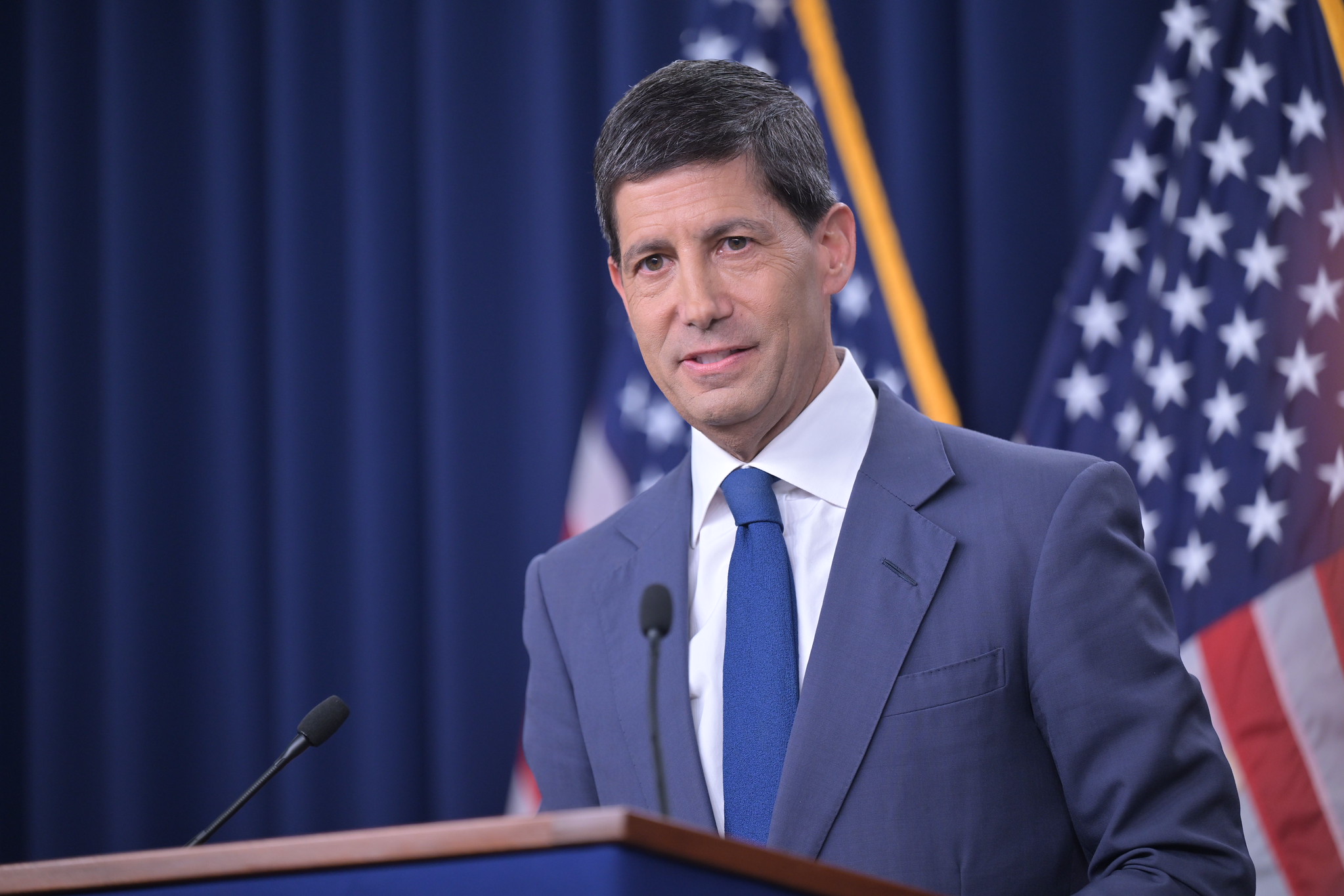
Fed Chair Kevin Warsh and his colleagues left interest rates unchanged on July 29. Image source: Official Federal Reserve Photo.
Although Warsh and the FOMC left the federal funds target rate unchanged at 3.5%-3.75%, the reaction in the bond market strongly suggests traders aren’t convinced that the central bank will stand pat while interest rates remain elevated.
Warsh sheds forward-looking guidance and doubles down on price stability
Unlike the new Fed chair’s first meeting in June, the July FOMC meeting featured dissension within the ranks. While a majority of FOMC members (nine) voted in favor of leaving the federal funds target rate unchanged, three members dissented in favor of a quarter-point rate hike. It’s the first time we’ve observed three dissents in the same policy direction since September 2016.
Warsh, for his part, has welcomed these so-called family feuds. After all, he inherited a historically divided Fed precisely as trailing 12-month U.S. inflation reached a three-year high in May.
Despite this less-than-ideal scenario, Kevin Warsh has promised to deliver price stability on several occasions, including at his most recent FOMC press conference.
Ahh… this comment is why the market freaked out.
Kevin Warsh keeps saying growth is “strong” but his actions and refusal to admit this is a pause, say the complete opposite.
“Shocks” = economic shocks
He’s worried about growth (as he should be). https://t.co/VVefIdnOax pic.twitter.com/UO4aj7LTNs
— Financelot (@FinanceLancelot) July 29, 2026
He’s also shed forward-looking guidance from FOMC meeting statements, which had been a staple for more than two decades. Without these clues as to what policymakers may do next, a level of uncertainty has been introduced that simply hasn’t existed in a long time.
But perhaps the biggest takeaway from the July FOMC meeting, from Warsh’s standpoint, is that he and his colleagues didn’t “pause” on interest rates — they conducted a “rigorous review.” Said the Fed chief in response to a question about the central bank’s “pause” on interest rates:
I wouldn’t characterize what we did as anything like a pause. I would characterize what we did as a rigorous review of the economic situation. I would characterize what we did as a review of the big, hard questions. And I’d characterize it as a view of what our own homework is to resolve those questions in the period ahead.
While Warsh admitted that several “economic shocks” are adversely impacting consumer prices, including energy supply disruptions and President Donald Trump’s tariffs, he framed the FOMC’s latest decision as a waiting game that would deliver clearer data and a decisive path forward in the coming months.

Image source: Getty Images.
The U.S. bond market is decisively calling the Fed chair’s bluff
But just because America’s foremost financial institution stood pat on interest rates, it doesn’t mean that lending rates haven’t shifted since Kevin Warsh was sworn in as the 17th head of the Fed.
Shortly after the Federal Reserve announced its policy decision at 2 p.m. ET on July 29, investors witnessed an immediate reaction at the long end of the Treasury yield curve. The yield curve, which depicts the relationship between bond yields and the time to maturity of those bonds, usually slopes up and to the right. Typically, the longer an individual’s capital is tied up, the higher the yield.
Changes at the long end of the yield curve, such as 10-year and 30-year Treasury bonds, can occasionally speak volumes about the trajectory of the Fed’s monetary policy. Following the FOMC’s decision, the 30-year Treasury yield soared above 5.2% to its highest level in roughly 19 years. Meanwhile, the 10-year Treasury yield, which often acts as a benchmark for mortgage rates, surged to around 4.7% and is nearing its highest level since the financial crisis.
According to Warsh’s prepared remarks to the press:
The first [economic development] is a very notable change since our last meeting 42 days ago: nominal and real yields are materially higher across the Treasury curve. In fact, some of the increases in market interest rates between FOMC meetings are among the most significant in the last two decades, ranking around the top decile or so.
This steady rise in long-dated bond yields since Warsh became Fed chair indicates that the bond market expects the historically hawkish head of the central bank and his colleagues to raise interest rates in the presumed not-too-distant future.
BREAKING: Fed Chair Kevin Warsh says the Fed didn’t need to raise rates today because the bond market already did the job for it.
Here’s what he said:
– Inflation is still above the Fed’s 2% goal. The Committee says it will deliver price stability, no exceptions.
– There is no… pic.twitter.com/jkw990Knge
— Bull Theory (@BullTheoryio) July 29, 2026
Furthermore, one of Warsh’s newest reforms may be one of the top catalysts driving long-dated Treasury yields higher. Although persistently high inflation and several economic shocks are the primary catalysts behind investors selling bonds and driving up their yields, Warsh’s decision to abandon forward-looking guidance is probably playing a role.
Without forward-looking guidance, bond traders are apt to be more cautious in an environment with above-average inflation. In other words, they’re more likely to sell long-dated bonds, thereby pushing up yields. Ironically, the bond market is helping Kevin Warsh modestly raise interest rates without the Federal Reserve adjusting its policy. Nevertheless, the long end of the yield curve points to the FOMC eventually raising interest rates.
The bond market calling Warsh’s bluff is potentially terrible news for a historically pricey stock market that’s been driven by the artificial intelligence (AI) data center build-out. If Treasury bonds continue to climb and the Fed (eventually) raises interest rates, higher borrowing costs can slow or stymie the pace of AI infrastructure expansion. This would represent a hiccup that a priced-for-perfection stock market can ill afford.